

The common human experience of time seeming to pass with extreme rapidity during sleep is a complex neuropsychological phenomenon. It is not an indication of time actually accelerating, but rather a direct consequence of fundamental shifts in brain function, consciousness, and memory processing. During sleep, particularly in the non-rapid eye movement (NREM) deep sleep stages, the brain's primary time-keeping mechanisms, largely centered in the prefrontal cortex, exhibit significantly reduced activity. Concurrently, the formation of new episodic memories—the very memories that create a subjective sense of duration—ceases. The brain instead prioritizes memory consolidation and physiological restoration. The thalamus acts as a gate, blocking most external sensory stimuli from reaching the cortex, which further removes the temporal anchors used during wakefulness. The result is a form of temporal amnesia where the hours spent unconscious are not recorded by the conscious mind, creating the perception of an instantaneous jump from falling asleep to waking. This subjective experience is a hallmark of healthy, restorative sleep architecture.
You lay your head on the pillow, close your eyes, and in what feels like a single, seamless moment, your alarm is blaring, demanding you greet a new day. Eight hours have disappeared from your life, leaving behind no trace, no memory, just a void between the moment of surrender to slumber and the abrupt return to consciousness. Where did that time go? Have you ever paused to truly contemplate this bizarre and universal human experience? It’s a phenomenon so common we rarely give it a second thought, yet it touches upon the deepest questions of consciousness, memory, and our subjective reality. The feeling that sleep is a form of time travel, a jump cut in the film of our lives, is not a malfunction or a trick of a tired mind. It is a profound clue about what your brain is doing when you are not "there" to witness it.
This exploration is a journey into the quiet, dark theater of the sleeping brain. We will move beyond simple answers and examine the intricate neural choreography that explains why sleeping feel so fast. Think of it not as lost time, but as time purposefully surrendered for the sake of restoration, repair, and recalibration. We will dissect the roles of different brain regions, investigate the strange elasticity of time during dreams, and understand how the very chemistry of your brain transforms each night.
Understanding this process is more than an intellectual curiosity. It reframes your relationship with sleep. That feeling of a night passing in an instant is not something to be lamented; often, it is a sign that your brain has achieved the deep, uninterrupted rest it desperately needs. It is a signal of health. By the end of our discussion, you will not only have a scientific answer to a common question but also a deeper appreciation for the silent, powerful work that occurs during those hours you can’t remember.
The primary reason for the sensation of rapid time passage during sleep lies in a deliberate and systematic shutdown of the very brain networks responsible for perceiving time. Your brain doesn't just passively drift into unconsciousness; it actively suppresses the functions that anchor you in the temporal world. It is an orchestrated event, a drawing of the curtains on conscious awareness.
Imagine the conductor of an orchestra. This individual keeps the tempo, cues the different sections, and ensures the entire piece flows together as a coherent whole. In the brain, the prefrontal cortex, particularly the dorsolateral prefrontal cortex, acts as this conductor for our conscious experience, including our sense of time (Nobre & van Ede, 2018). When you are awake, this brain region is buzzing with activity. It is engaged in executive functions: planning your day, solving problems, and maintaining self-awareness. A crucial part of this job is metacognition, or thinking about your own thoughts, which includes monitoring the passage of time. It integrates information from your senses, your memories, and your internal state to create a continuous, flowing timeline of the present moment.
When you fall into deep, slow-wave sleep, this conductor effectively leaves the stage. Brain imaging studies show a dramatic decrease in activity in the prefrontal cortex. This deactivation, known as hypofrontality, is not a bug; it's a feature of restorative sleep. The brain needs to take its executive control center offline to perform other vital maintenance tasks, such as clearing metabolic waste products that accumulate during the day.
Without the prefrontal cortex actively monitoring and sequencing events, there is no "observer" to register that seconds are turning into minutes and minutes into hours. The mechanism that generates the feeling of duration is simply switched off. When you awaken, your brain has no record of that time passing because the part of it that does the recording was on a scheduled break. The result is the perception of a jump, a temporal leap from the moment you lost consciousness to the moment you regained it.
For the prefrontal cortex to truly rest, it needs to be shielded from the constant barrage of information from the outside world. This is where another key brain structure, the thalamus, comes into play. The thalamus acts as the brain's central relay station or gatekeeper for sensory information. Nearly everything you see, hear, and feel passes through the thalamus on its way to the cortex for processing.
During wakefulness, this gate is wide open. But as you fall asleep, the thalamus begins to close it. This process, called thalamic gating, is orchestrated by inhibitory neurons that reduce the flow of sensory signals to the cortex. It is why you can sleep through the familiar hum of a fan but might be jolted awake by the unfamiliar sound of a smoke alarm; the thalamus is selectively filtering what it deems non-threatening.
In deep sleep, this gate is almost entirely shut. The sights, sounds, and sensations of your environment no longer reach the conscious processing centers of your brain. These external stimuli are the anchors we use to gauge time when we are awake—the changing light from a window, the distant sound of traffic, the feeling of the sheets against our skin. With these temporal markers gone, your brain is cast adrift from the external world's rhythm. Combined with the offline prefrontal cortex, this sensory deprivation leaves your brain with absolutely no data points to construct a sense of duration.
To better grasp the uniqueness of sleep, it can be helpful to compare it to other states of unconsciousness, such as being under general anesthesia or in a coma. While all involve a loss of awareness, the underlying neural mechanisms and the subjective experience of time can differ.
General anesthesia, like sleep, often produces a profound sense of "lost time." Many patients report closing their eyes and then, in the next perceived moment, waking up in the recovery room. This is because many anesthetic agents work by enhancing the activity of GABA, the brain's primary inhibitory neurotransmitter, which effectively dampens neural activity across the cortex, including in the prefrontal regions and thalamus, mimicking the deep sleep state.
A coma, however, is different. It is a pathological state of prolonged unconsciousness caused by severe brain injury or illness, not a healthy, cyclical biological process. While a person in a coma also has no perception of time's passage, the brain is in a state of severe dysfunction, not restorative maintenance.
The key difference is that sleep is a precisely regulated, reversible, and necessary process. The shutdown of your time perception machinery is a deliberate, nightly event designed to facilitate health. It is not a sign of damage but of a system working exactly as it should. That feeling of a night passing in an instant is the subjective echo of your brain prioritizing its own well-being over the task of watching the clock.
Our perception of time is inextricably linked to memory. Think about a day that was packed with new experiences—a trip to a new city, a wedding, the first day at a new job. In hindsight, that day often feels long and substantial. Why? Because you formed dozens, if not hundreds, of new episodic memories. These memories act as mental signposts, creating a rich and detailed timeline you can mentally revisit. The more signposts you have, the longer the journey feels. During sleep, your brain’s relationship with memory undergoes a fundamental reversal, which is a second major reason why sleeping feel so fast.
When you are awake, your brain is in the business of acquisition. It is constantly creating new episodic memories—memories of specific events, or "episodes," tied to a particular time and place. Remembering what you had for breakfast, the conversation you had with a colleague, and the movie you watched in the evening are all examples of episodic memories. The hippocampus, a seahorse-shaped structure deep in your brain, is a key player in forming these new memories. It acts like a temporary scratchpad, holding onto the day's events before they are processed for long-term storage.
When you fall asleep, the brain's priority shifts from acquisition to consolidation. Instead of recording new experiences, it begins to sort, file, and strengthen the important memories from the day. As neuroscientist Matthew Walker explains in his work, sleep is not an empty state but a highly active one for memory processing (Walker, 2017). During this time, the hippocampus "replays" the neural patterns of recent experiences, transferring them to the neocortex for more permanent storage. This is how we learn and retain information.
The consequence of this shift is that you are not forming any new episodic memories of the night itself. Your brain is not recording the experience of lying in bed, the feeling of the hours passing, or the subtle changes in your room. It is busy working on its internal files.
Imagine a librarian at the end of the day. The doors are locked, no new patrons are coming in, and no new books are being checked out. The librarian's job now is to take the cart of returned books, sort them, and place them back on the correct shelves for future access. The hippocampus at night is like that librarian. It is no longer taking in new information from the "patrons" (your senses). Instead, it is replaying the day's events—often at an accelerated speed—to facilitate their transfer to the vast library of the neocortex.
This replay process is most prominent during slow-wave sleep and REM sleep. The dialogue between the hippocampus and the neocortex is what helps you wake up with a clearer understanding of a problem or with a skill more firmly ingrained than when you went to bed. But because the brain is internally focused on this "filing" task, it is not creating a new file for the night itself. The librarian has no memory of the hours spent shelving books, only of the books themselves.
The result of this lack of memory formation is a state that can be described as "temporal amnesia." You remember the event of going to bed, and you remember the event of waking up. These are two distinct episodic memories. However, the time in between is a blank. There are no mental signposts, no temporal landmarks, to give that period any subjective length.
Your brain, in its attempt to create a coherent narrative of your existence, simply stitches the last moment of waking consciousness to the first moment of returning consciousness. The intervening eight hours, devoid of any recorded experience, collapse into nothing. It is the ultimate cognitive shortcut. The brain concludes that if it has no memory of time passing, then for all practical purposes, no time has passed.
This is fundamentally different from a boring afternoon where time seems to drag. During that boring afternoon, you are still forming memories—the memory of looking at the clock, the memory of your own thoughts, the memory of the room around you. These memories, though dull, still provide a framework of duration. Sleep provides no such framework. It is a true void in your experiential record, a deliberate and healthy amnesia that allows your mind to prepare for the next day's worth of memories.
Not all sleep is created equal. Throughout the night, your brain cycles through several distinct stages, each with a unique pattern of brain activity, and each with a profoundly different relationship to time perception. A typical night consists of four to six of these cycles, each lasting about 90 minutes. Understanding this architecture is key to appreciating why the first half of the night can feel like a complete blackout while the second half might contain strange, time-bending narratives.
| Sleep Stage | Brain Wave Type | Typical Duration Per Cycle | Conscious Awareness Level | Time Estimation Accuracy When Awakened |
|---|---|---|---|---|
| NREM Stage 1 | Alpha & Theta waves | 1–5 minutes | Low, drifting | Poor, often feels like you weren't asleep |
| NREM Stage 2 | Sleep spindles, K-complexes | 10–60 minutes | Very low | Poor, significant underestimation |
| NREM Stage 3 (Deep Sleep) | Delta waves | 20–40 minutes (early cycles) | Near zero | Extremely poor, severe underestimation, disoriented |
| REM Sleep | Mixed frequency (resembles wake) | 10–60 minutes (increases through night) | High (dreaming), but disconnected | Highly variable, distorted by dream content |
When you first close your eyes, you enter NREM Stage 1. This is a very light, transitional stage of sleep. Your brain waves begin to slow from their waking alpha rhythm to a more relaxed theta rhythm. You might experience strange sensations or muscle twitches (hypnic jerks). In this stage, your awareness of time is still partially intact. If you are woken up, you might even deny you were asleep at all, but you would likely have a somewhat accurate sense that only a few minutes have passed.
Soon, you descend into NREM Stage 2. This is where you spend the largest portion of your sleep time, about 50% of the night. Your brain activity is characterized by sleep spindles and K-complexes—bursts of neural activity that are thought to help with memory consolidation and keeping you asleep through minor disturbances. Your consciousness has faded significantly, and your perception of time becomes much less reliable. If awakened from this stage, you would likely underestimate how long you had been asleep, but you might still have a vague sense of duration. It is like the world is fading to a distant murmur.
From Stage 2, you enter the deepest phase of sleep: NREM Stage 3, also known as slow-wave sleep. Here, your brain produces large, slow, synchronized delta waves. This is the most restorative stage of sleep, where your body does most of its physical repair and growth. Your prefrontal cortex is at its quietest, and your thalamic gate is shut tight.
In this stage, conscious awareness and time perception are completely absent. This is the "void" or "blackout" period of sleep. There is no self, no experience, and therefore, no time. Research confirms that individuals awakened from deep sleep are the most disoriented (a phenomenon called sleep inertia) and have the worst time estimation, often underestimating the duration of their slumber by a massive margin (Waking.io, n.d.). This stage dominates the early part of the night. The fact that you get your largest doses of this time-annihilating sleep in the first few hours after falling asleep is a major reason why an entire night can feel so compressed.
After a period of deep sleep, you ascend back through Stage 2 and then enter a completely different realm: REM (Rapid Eye Movement) sleep. This stage is a paradox. Your brain activity looks remarkably similar to when you are awake, with fast, desynchronized brain waves. Your heart rate and breathing become irregular. Your eyes dart back and forth behind your closed eyelids. Yet, your body is almost completely paralyzed, a protective mechanism to prevent you from acting out your dreams.
This is the stage where most vivid, narrative-style dreaming occurs. And within these dreams, time becomes incredibly elastic. You might experience a dream that feels like it spans days, weeks, or even a lifetime, all within a 20-minute REM period. Conversely, a brief, fleeting dream image might occur over several minutes of real time. Time in dreams can loop, jump, or slow to a crawl.
Unlike deep sleep, where time is absent, REM sleep creates its own internal, distorted timeline. The prefrontal cortex is still relatively inactive, which is why dreams are often illogical and bizarre. We accept these temporal impossibilities without question. Because we sometimes remember these dream narratives, they can give the night a sense of substance that the void of deep sleep lacks. This is why the later part of the night, which is richer in REM sleep, can sometimes feel subjectively longer than the first part. Yet, this dream-time rarely aligns with clock time, making it an unreliable measure of duration. A deeper understanding of your sleep architecture can be achieved with tools like a modern smart ring that tracks your sleep stages.
Your brain’s state of consciousness is governed by a complex and delicate balance of chemicals. The shift from wakefulness to sleep involves a profound transformation in your brain's neurochemical environment. This "chemical cocktail" not only makes you sleepy but also fundamentally alters the brain's ability to process temporal information, providing another layer of explanation for why sleeping feel so fast.
Think of it like a corporate office. During the day, the "day crew" of neurotransmitters is active, focused on alertness, motivation, and processing external information. At night, the "night shift" takes over, and their priorities are completely different: rest, repair, and internal maintenance. The time clock is not on their list of duties.
| Neurotransmitter | Typical Waking Level | Typical Sleep Level | Primary Role in Time Perception |
|---|---|---|---|
| Dopamine | High | Low (especially in NREM) | Drives motivation and internal clock speed; lower levels slow subjective time. |
| Norepinephrine | High | Near zero (especially in REM) | Maintains vigilance and attention to external time cues. |
| Serotonin | High | Progressively decreases | Helps sequence events and maintain a stable internal clock. |
| Acetylcholine | Varies | Low in NREM, High in REM | High levels in REM drive dream activity but without temporal logic. |
| GABA | Low | High | The primary inhibitory chemical; actively suppresses time-tracking neural circuits. |
| Melatonin | Low (day) | High (night) | Signals circadian night; influences the master clock but not conscious time perception. |
 Norepinephrine
During your waking hours, several key neurotransmitters keep you alert and tethered to the flow of time.
The quieting of this "day crew" is essential for allowing the brain to disengage from the external world and begin its restorative work. A side effect of their absence is that the brain's time-keeping abilities are severely handicapped.
As the day crew clocks out, the night shift takes over, led by two prominent chemicals.
This complete change in the neurochemical landscape means the brain is operating under a different set of rules at night. The very chemistry required for perceiving time is replaced by a chemistry designed for restoration and disconnection.
You might wonder, if the brain's time perception is off, how does it know when to wake up? The answer lies in the suprachiasmatic nucleus (SCN), a tiny cluster of nerve cells in the hypothalamus. The SCN is your body's master biological clock. It runs on an approximately 24-hour cycle, synchronized by light exposure from your eyes.
Crucially, the SCN keeps ticking away accurately throughout the night, tracking objective, circadian time. It governs the timing of your sleep cycles and the release of hormones like melatonin and cortisol (which helps you wake up). However, the SCN is disconnected from your conscious time perception networks in the cortex.
Think of the SCN as the master clock in a power plant that keeps the city's grid on schedule. During the night, the power to the clocks in every house (your conscious mind) is cut off for maintenance. The clocks in the houses stop. But the master clock at the plant keeps running perfectly. 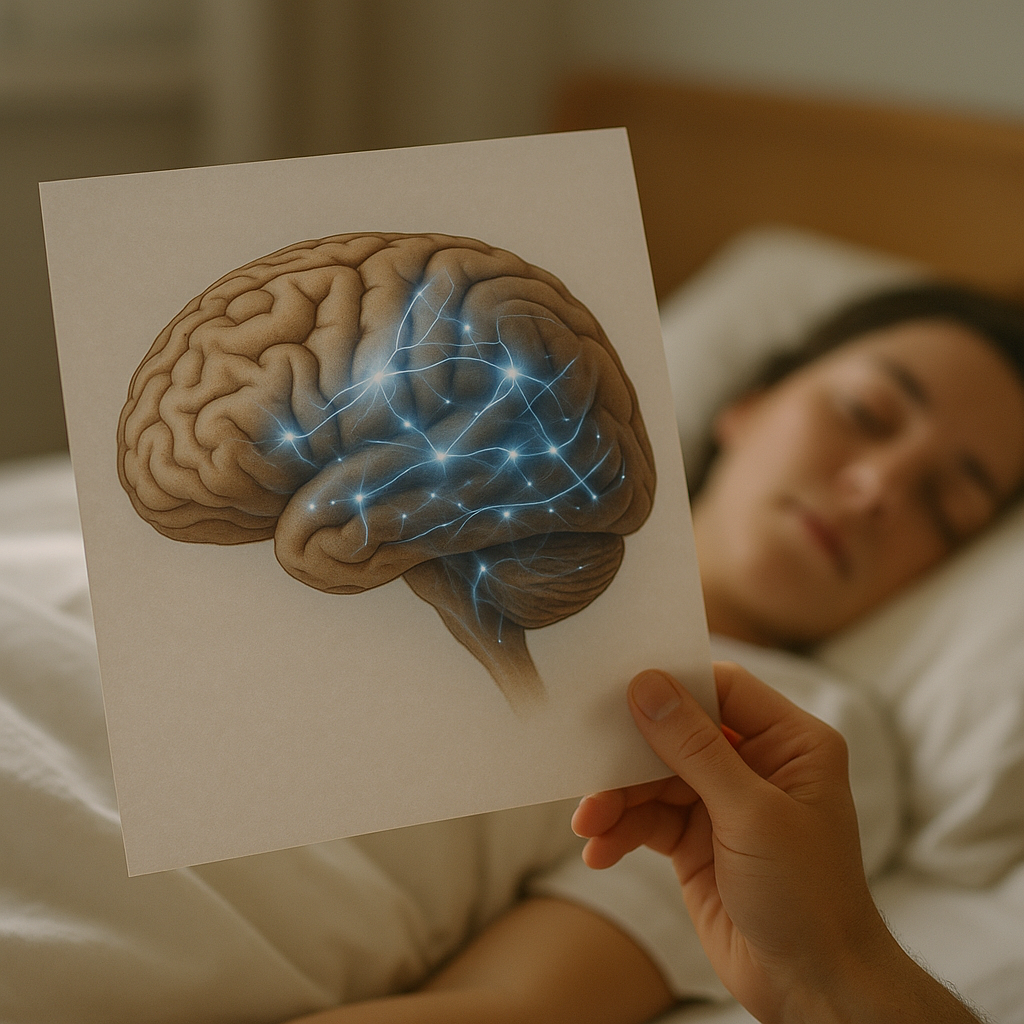 When the power comes back on in the morning, the house clocks start ticking again, but they have no record of the time that passed during the outage. The SCN ensures you wake up at the right biological time, but it does not provide your conscious mind with a minute-by-minute report of the night.
While the dominant experience is that good sleep feels fast, many people have had nights that seemed to drag on forever. You might have slept for seven hours but feel as though you were tossing and turning for an eternity. This paradox provides the final piece of our puzzle: the subjective speed of sleep is directly related to its quality. A night that feels fast is generally a night of high-quality, consolidated sleep. A night that feels long is often a sign of fragmented, poor-quality sleep.
High-quality sleep is continuous. It involves smooth transitions through the sleep stages with minimal interruption. Poor-quality sleep, on the other hand, is fragmented. It is riddled with brief arousals or "micro-awakenings." These can be so short—just a few seconds—that you have no explicit memory of them in the morning. However, during each of these moments, your consciousness flickers back on.
When your consciousness returns, so does your brain's time-keeping machinery. For that brief period, your brain creates a "time stamp," a small island of recorded experience in the sea of unconsciousness. Even if you don't remember the awakening itself, the accumulation of these time stamps throughout the night can alter your subjective sense of duration. Instead of one solid block of "lost time," the night becomes a series of shorter unconscious periods punctuated by moments of awareness. This gives the brain more data points to construct a timeline from, making the night feel subjectively longer and more drawn out.
What causes these micro-awakenings? A variety of factors can fragment your sleep.
This brings us to a powerful reframing of our central question. The sensation of why does sleeping feel so fast is not a problem to be solved. In most cases, it is a positive signal, a subjective marker of excellent sleep quality.
When a night passes in what feels like an instant, it suggests that you experienced long, consolidated bouts of deep, slow-wave sleep. It means your brain successfully shut down its conscious time-keeper, gated off external stimuli, and performed its vital restorative functions without interruption. You had few, if any, micro-awakenings to create those unwanted temporal signposts.
So, the next time you wake up shocked that your alarm is already going off, instead of feeling cheated out of time, you might consider it a sign of a job well done. Your brain did exactly what it was supposed to do. It took the time it needed for itself, and as a result, gave you the gift of a seamless, instantaneous journey from dusk till dawn. Embracing this perspective means understanding why does sleeping feel so fast is the first step toward appreciating the quality of your rest.
Why do some naps feel long while a full night's sleep feels short?
This common experience comes down to sleep stages and sleep pressure. When you take a short nap, you often remain in the lighter stages of NREM sleep (Stages 1 and 2), where some level of conscious awareness and time perception persists. If you are very tired (high sleep pressure) and fall into a long nap that enters deep, slow-wave sleep, you can wake up disoriented with that "lost time" feeling. Conversely, a full night of healthy sleep ensures you spend significant time in the complete "blackout" of deep sleep, causing the entire eight-hour period to feel compressed.
Does dreaming make the night feel longer or shorter?
Dreaming, which occurs primarily during REM sleep, has a variable effect. Because dreams create narratives and experiences, remembering a dream can make the night feel more substantial and subjectively longer than a night with no dream recall. However, the perception of time within the dream itself is highly distorted and does not reflect real clock time. A dream that felt like it lasted for hours may have only occurred over a 20-minute REM period. So, while it can add "content" to the night, it doesn't provide an accurate sense of duration.
Is it possible to learn to be aware of time while sleeping?
For most people, no. The shutdown of the brain's time perception networks is a fundamental and involuntary part of the sleep process. However, some individuals who practice lucid dreaming—the skill of becoming aware that you are dreaming while in the dream—can perform experiments. Studies on lucid dreamers have shown that their estimation of time while performing tasks within a dream (like counting) can be surprisingly accurate, closely matching real-world time (LaBerge, 2000). This suggests that a form of temporal awareness can be accessed in the unique state of REM sleep, but it is not the typical sleep experience.
If I wake up feeling like no time has passed, does it mean I slept well?
Generally, yes. The feeling of time passing in an instant is a strong subjective indicator of consolidated, uninterrupted sleep, particularly with healthy amounts of deep, slow-wave sleep. If your sleep is fragmented by frequent awakenings (due to stress, a sleep disorder, or a poor environment), you will have more moments of consciousness during the night, which makes the night feel subjectively longer and less restful.
Why does time seem to drag when I'm trying to fall asleep with insomnia?
This is the flip side of the coin. When you are lying in bed with insomnia, your brain remains in a state of hyperarousal. Your prefrontal cortex is active, you are acutely aware of your surroundings, and you are forming memories of your frustration and the minutes ticking by. Because your conscious time-keeping mechanisms are fully engaged—and you are focused on them—time can feel painfully slow and drawn out.
The nightly disappearance of time is not a glitch in our perception but a feature of our biology, a testament to the brain's incredible ability to prioritize and self-regulate. The feeling of a night passing in the blink of an eye is the subjective footprint of a brain hard at work on its most vital, behind-the-scenes tasks: repairing tissues, consolidating memories, and clearing out the metabolic debris of a day's worth of thinking. It is a sign that the conductor of your consciousness has stepped off the podium, the gates of perception have been closed, and the silent librarian of the hippocampus is diligently organizing the shelves of your mind.
To understand why sleeping feel so fast is to re-evaluate our relationship with those lost hours. We live in a culture that often views sleep as an inconvenience, a period of unproductive downtime. But the science of temporal perception during sleep reveals the opposite. That void is not empty; it is filled with the most productive work our body does. It is a period of profound restoration that is so all-consuming that the brain must dispense with the luxury of watching the clock.
So, when you next awaken with a jolt, surprised by the morning light, take a moment. Instead of lamenting the speed of the night, consider it a quiet confirmation of a job well done. It is a signal that you have been granted the deep, continuous rest that is the very foundation of a healthy mind and body. In a world that demands our constant attention, the brain's nightly decision to let time disappear is perhaps its greatest act of self-care.
LaBerge, S. (2000). Lucid dreaming: Evidence and methodology. Behavioral and Brain Sciences, 23(6), 962–964.
Nobre, A. C., & van Ede, F. (2018). The neural basis of time: A network perspective. Nature Reviews Neuroscience, 19(4), 235–252. https://doi.org/10.1038/nrn.2017.169
Soares, S., Atallah, B. V., & Paton, J. J. (2016). Midbrain dopamine neurons control judgment of time. Science, 354(6317), 1273–1277. https://doi.org/10.1126/science.aah5234
Smore Science. (n.d.). Why does sleeping go by so fast? Smore Science. https://www.smorescience.com/why-does-sleeping-go-by-so-fast/
Science Focus. (n.d.). Why does time go so fast when you’re asleep? BBC Science Focus Magazine. https://www.sciencefocus.com/the-human-body/why-does-time-go-so-fast-when-youre-asleep
Neurolaunch. (2024). Time perception during sleep: Why hours feel like minutes. https://neurolaunch.com/why-does-time-go-by-so-fast-when-you-sleep/
Walker, M. (2017). Why we sleep: Unlocking the power of sleep and dreams. Scribner.
Waking.io. (n.d.). Why does time go by so fast when you sleep? Science explains. https://waking.io/blog/why-does-time-go-by-so-fast-when-you-sleep/
Eons. (n.d.). Why does time go by so fast when you sleep? A guide. https://eons.com/blogs/deeper-sleep-with-quicksome/why-does-time-go-by-so-fast-when-you-sleep
CantSleep.org. (n.d.). Why does time go by so fast when you sleep?https://cantsleep.org/why-does-time-go-by-so-fast-when-you-sleep/

